From the desk of the CMO
While the phrase “The only easy day was yesterday” is a motto attributed to U.S. Navy SEAL teams, it certainly has applicability to healthcare and other industries. In essence it means: Challenges are constant and ongoing; as you overcome one set of difficulties you can expect that the next day may bring new (and often tougher) obstacles. This philosophy is meant to instill a mindset that one must never stop pushing his/her limits and striving to grow.
In much the same way, hospital decision-makers are faced with a dual-faceted imperative—achieving cost efficiencies while ensuring patient safety and quality outcomes. Even though the path may not be easy, I encourage providers to face these and other performance improvement challenges head on.
Physicians want to be part of the solution
Many physicians recognize the importance of understanding the cost of care, with a significant majority agreeing they have a responsibility to control costs and reduce unnecessary utilization. In a recent survey, 63% of physicians reported that they consider the cost of care “all” or “most of the time” when making treatment choices. However, 72% express uncertainty about the costs associated with the treatments they provide.
Standardizing on PPI
Engaging physicians is fundamental to managing supply costs. Their firsthand knowledge of clinical needs enables effective standardization of physician preference items (PPIs) that balances quality and cost.
However, PPI standardization efforts often encounter barriers from both administrators and physicians. Hospitals may consider the standardization process controversial, citing provider skepticism, competing demands for physicians’ time or fear of alienating a referral source. For their part, physicians sometimes resist with concerns related to individual autonomy, choice and patient care.
Optimizing clinical supply spend is essential
Despite the challenges, health systems can no longer afford to avoid addressing physician preference head on. The impact of PPIs alone on a hospital’s expenses, revenue and margins can be considerable:
- 5% to 15% potential savings from a health system’s external spend baseline after identifying and implementing spend optimization opportunities. This is in addition to the savings gained from simply negotiating prices.
- PPI typically represents just 3% of purchase orders; however, it accounts for 20% of a health system’s total supply chain spend.
Overcoming irrational fears
It’s long been understood that physicians have disproportionate influence over the cost of care through their ordering decisions. But their professional culture also aspires to protect quality of care despite downward pressures on cost. I believe we are afraid to use evidence-based strategies and strong clinical financial decision-making to address PPI based upon an irrational fear of losing a physician’s loyalty.
In my experience working with physicians and hospitals routinely on this issue, the pushback isn’t really from the physicians; most often it is reticence on the part of hospital leadership. Securing buy-in from hospital leadership is essential to prioritize and successfully achieve PPI standardization.
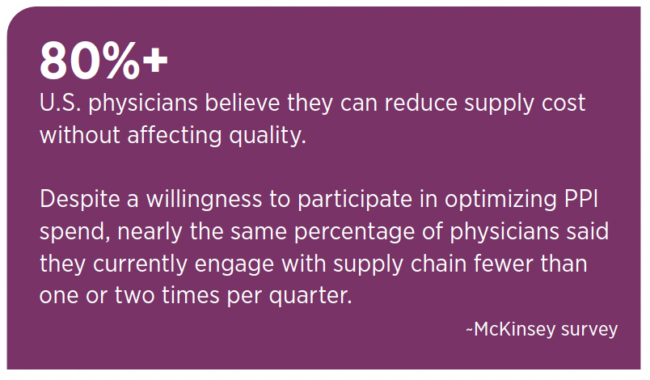
If done correctly, physicians are willing to get on board with supply chain transformation when they are confident that a health system is putting patients first. Physicians view managing these costs as part of their responsibility and indicate they would like to be involved with supply chain initiatives.
5 essential steps to overcoming physician objections
-
- Create a multidisciplinary collaborative environment. Perspective matters.
- Couple effective contractual strategies with appropriate clinical criteria. You can’t contract your way out of cost.
- Engage physicians in developing the solution. Seek physician involvement early in the process. Focus on evidence-based decision making and encourage transparent and open feedback. Create physician partners not participants.
- Lead with clinical and cost data. Share high quality studies and articles proving improved patient outcomes and cost savings. Embrace comparative effectiveness.
- Include education and training on “new” products. Unfamiliarity with standardized products is often expressed as a safety concern.
Through physician engagement, data-driven decision-making and a structured approach to value analysis, progressive health systems have demonstrated how the supply chain can evolve from an administrative function into a strategic clinical partner.
Overcoming physician objections requires effective communication, data-driven decision-making, collaboration and the right GPO partner. A recent study analyzing the effectiveness of healthcare GPOs found no evidence that their reduction of supply expenses comes at the cost of the quality of care, nor by means of selective patient admission.
Margin maximization is possible
At HealthTrust Performance Group our prescription for improving provider performance involves aligning physician, clinical, operational and financial leadership to drive cohesive decision-making and implementation. Our Performance Solutions team is made up of operators and business advisors who accelerate the delivery of margin maximization through the alignment of both clinical and financial goals. One of the tools used by our performance experts is Crimson AI powered by HealthTrust. Read more in Turning Insight Into Impact.
Aashish Shah, M.D., J.D.
Senior Vice President & Chief Medical Officer
HealthTrust Performance Group

Ready to implement a systemwide approach to solving your organization’s challenges? Reach out to me or your HealthTrust Account Manager to start the conversation. Our Performance Solutions experts stand ready to deliver measurable results. In the meantime, stay well.
Share Email Care Variation Utilization, Performance Improvement, PPI, Q1 2026